


Revision Rhinoplasty (Secondary Rhinoplasty)

Revision Rhinoplasty (Secondary Rhinoplasty)
Rhinoplasty is a delicate procedure aimed at improving both the aesthetic and functional aspects of the nose, which is located at the very center of the face. However, in some cases, the results of the initial surgery may not meet the patient’s expectations, or unexpected structural and functional issues may arise post-operatively. While experiencing disappointment after a first nose surgery can be emotionally taxing, it is possible to leave these concerns behind and achieve the natural, healthy nasal structure of your dreams through Revision Rhinoplasty (Secondary Rhinoplasty).
On this page, we explore what revision rhinoplasty is, the conditions in which it is performed, the surgical process, and all the essential details from an expert perspective.
What is Revision Rhinoplasty?
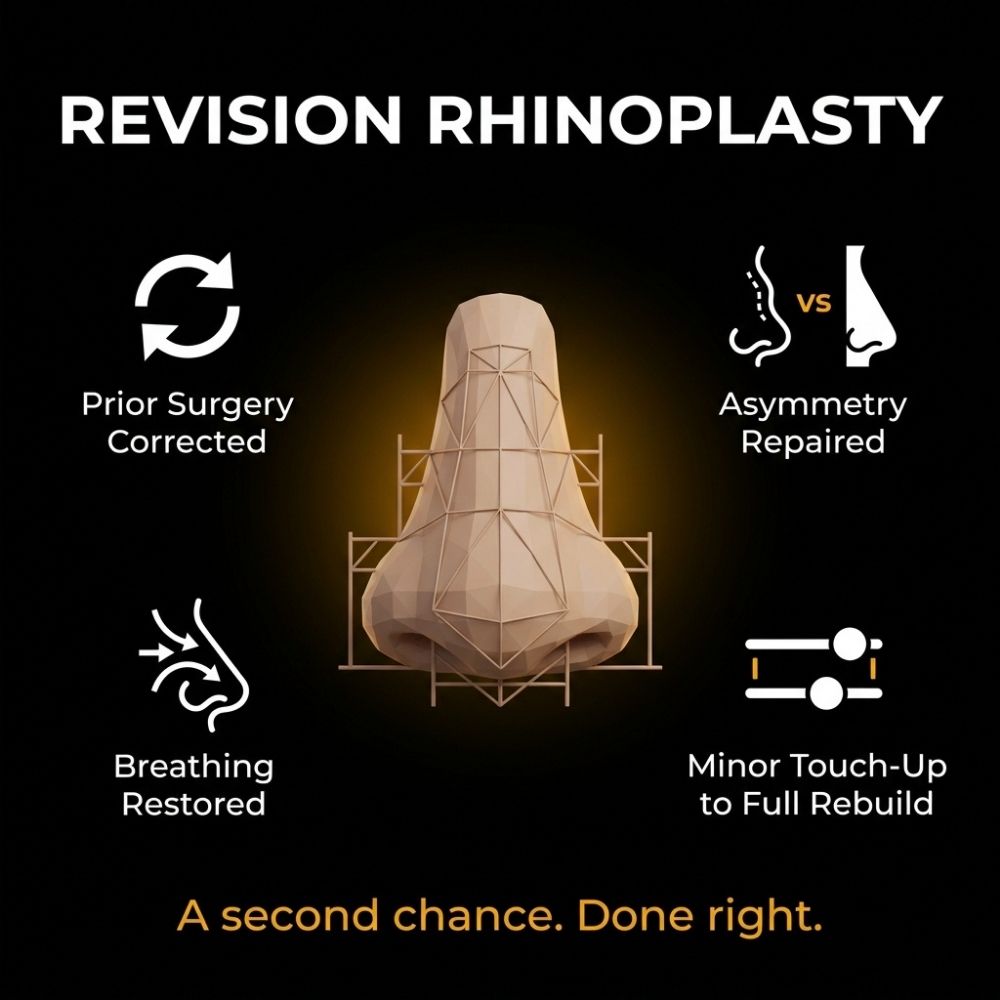
Revision rhinoplasty is the name given to corrective surgeries performed on patients who have undergone at least one previous rhinoplasty procedure but are dissatisfied with the aesthetic appearance or respiratory function of their nose. This procedure repairs asymmetries, cartilage collapse, drooping of the nasal tip, or narrowed airways resulting from the initial surgery.
Revision surgeries can be planned on different scales depending on the patient’s specific needs, ranging from “minor” (small touch-ups or slight rasping) to “major” (a complete reconstruction of the nasal skeletal framework).
When is Revision Rhinoplasty Needed?
Patients typically seek revision surgery months or even years after their initial procedure due to various concerns. These issues can be aesthetic, functional, or a combination of both:
1. Aesthetic Reasons
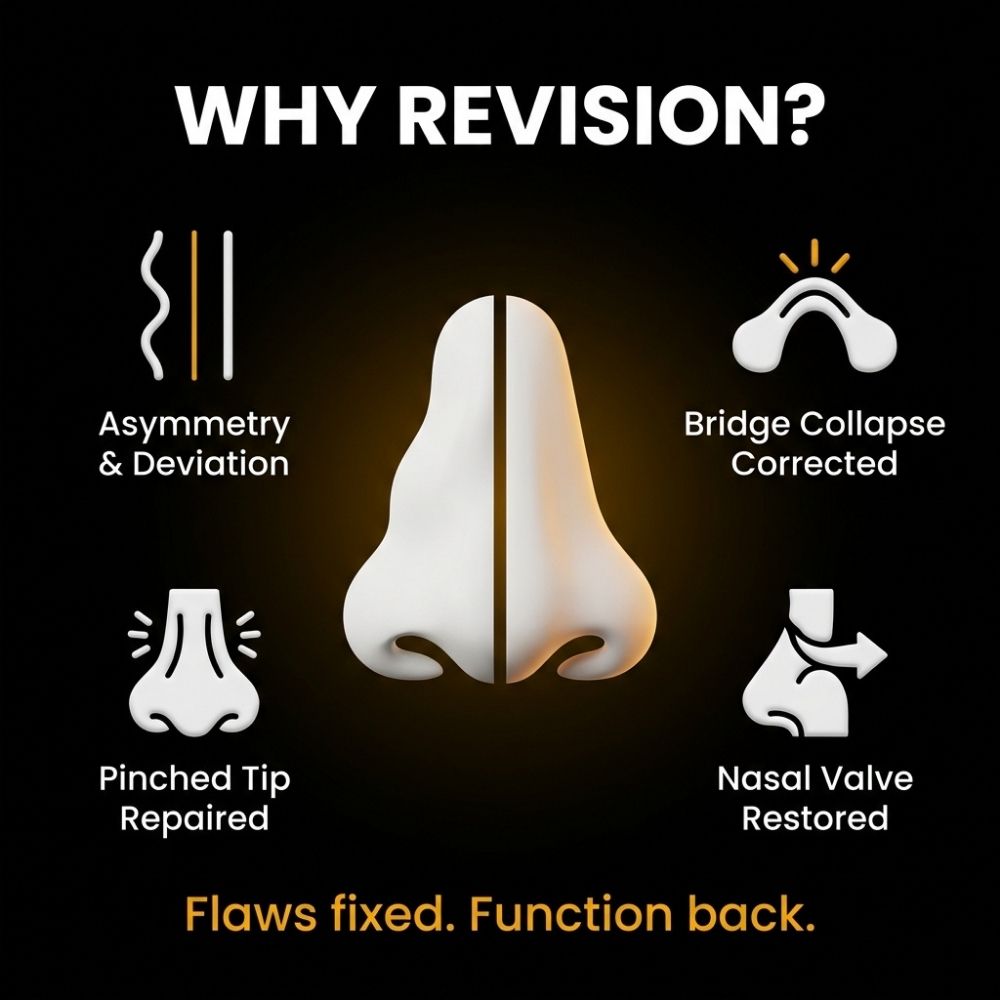
- Asymmetry and Deviation: Crookedness to the right or left that was either not fully corrected in the first surgery or developed during the healing process.
- Pollybeak Deformity: A “parrot-beak” appearance resulting from insufficient removal of the nasal bridge or an excessive drop in the nasal tip.
Saddle Nose Deformity: A collapse or “dipping” of the nasal bridge caused by the over-resection of cartilage and bone tissue.
Inverted-V Deformity: An upside-down “V” shape visible in the middle third of the nose, caused by the separation of the nasal cartilages from the bone.
Over-rotated (Upturned) Nose: An unnaturally high nasal tip that makes the nostrils excessively visible from the front.
Pinched Tip Appearance: A nasal tip that looks “pinched” or squeezed, often due to excessive narrowing of the tip cartilages.
2. Functional Reasons (Breathing Difficulties)
Nasal Valve Collapse: Weakening of the nasal sidewalls, causing the nostrils to collapse inward during deep inhalation.
Residual Deviation: Incomplete correction of the internal cartilage curvature (septal deviation) during the initial surgery.
Synechia (Tissue Adhesions): Post-operative scarring where internal mucosal tissues stick together, obstructing the airway.
Why is Revision Surgery More Complex?
Revision rhinoplasty is widely recognized in the surgical community as a procedure that is “far more challenging and requires higher expertise” than a primary surgery. There are several fundamental reasons for this:
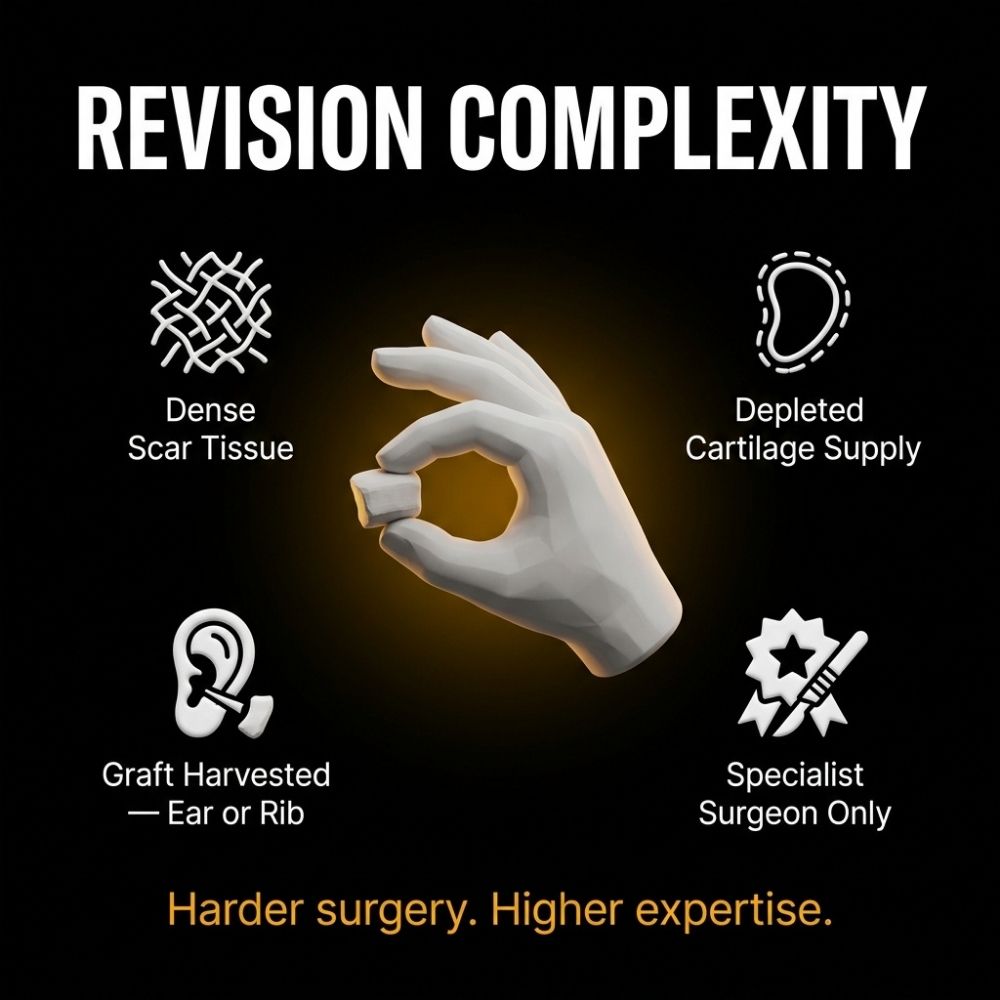
- Scar Tissue (Fibrosis): As tissues heal following the initial surgery, dense and adhesive scar tissue forms beneath the skin. This tissue complicates the identification of anatomical planes and makes reshaping the nasal structures significantly more difficult.
- Depleted Cartilage (Lack of Material): In rhinoplasty, the internal cartilage known as the septum is the primary source used to shape and support the nose. However, in revision patients, this cartilage has often been exhausted during the first operation. In such cases, to reconstruct the nose, cartilage grafts must be harvested from other donor sites, such as the ear (concha) or the rib (costal cartilage).
- Changes in Skin Quality: After multiple surgeries, the nasal skin may become thinner, and its blood circulation may be compromised. Conversely, it can also become excessively thick and lose its natural elasticity.
Due to these complexities, revision rhinoplasty should only be performed by experienced surgeons who have received specialized training in this field and possess a comprehensive command of nasal anatomy.
The Surgical Process and Cartilage Grafting (Using Rib or Ear Cartilage)
If your nose requires major reconstruction and your internal nasal cartilage is insufficient, your surgeon will utilize autologous (harvested from your own body) cartilage.
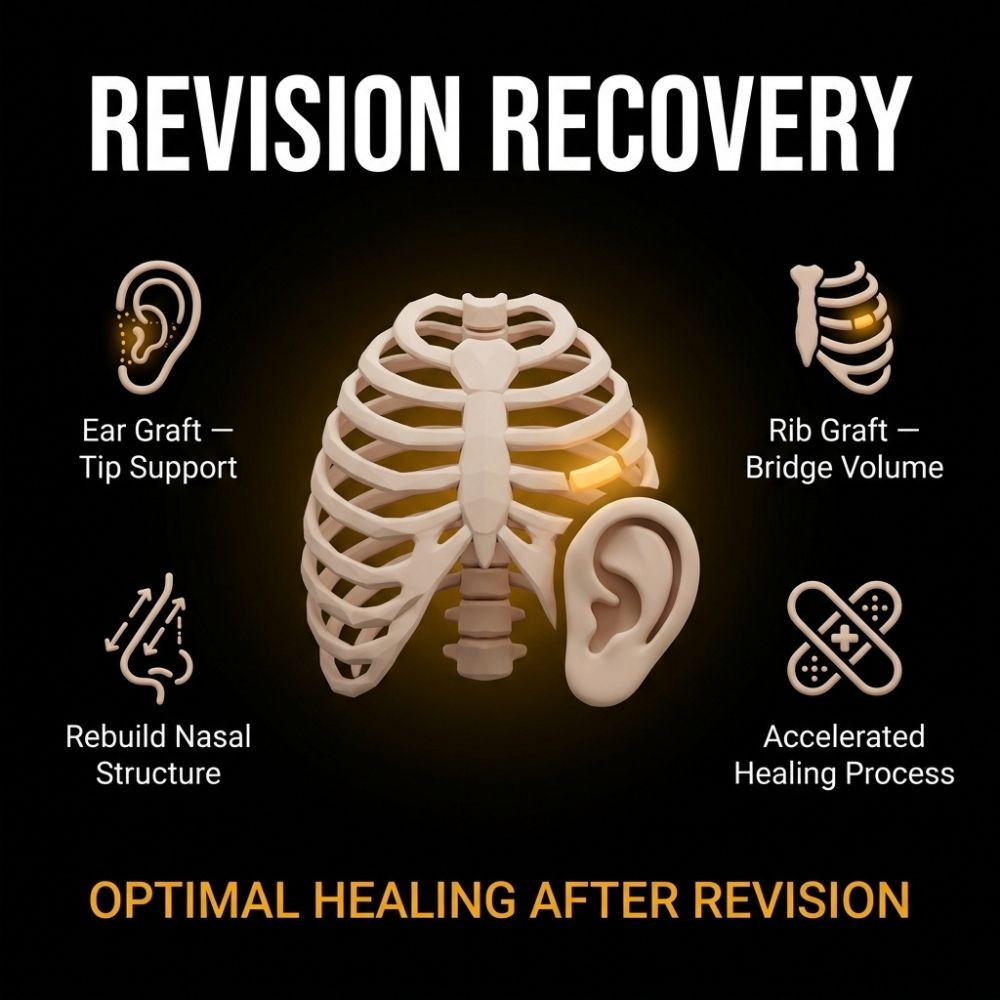
- Ear Cartilage (Conchal Graft): A small piece of cartilage is harvested from the back of the ear in a way that does not compromise its aesthetic appearance. This is typically preferred for minor repairs and providing support to the nasal tip.
- Rib Cartilage (Costal Graft): This is used in cases of severe collapse, full reconstruction (such as saddle nose), or when the nasal bridge needs to be entirely rebuilt. It is harvested through a small 3–4 cm incision at the lower part of the rib cage. Since it is your own tissue, there is zero risk of rejection.
The operation is performed under general anesthesia and, depending on the complexity of the case, typically lasts between 3 to 5 hours.
The Recovery Process: What to Expect?
The recovery process after revision surgery is similar to the primary procedure but carries some distinct differences:
- The First Week: Swelling (edema) and bruising may occur. It is normal to experience nasal congestion during the first few days. However, since new-generation silicone splints are used, breathing remains partially possible, and their removal is completely painless.
- Resolution of Edema: Due to tissue adhesions from previous surgeries, the resolution of swelling (edema) may be slightly slower than after a primary rhinoplasty. Major (gross) swelling typically subsides within 1–2 months.
- The Final Result: In revision rhinoplasty, it can take 1.5 to 2 years for the nose to reach its final shape and for the tissues to heal completely, depending on skin thickness. During this period, patience is essential, as is strictly following your doctor’s post-operative instructions (nasal massages, sun protection, etc.).
Frequently Asked Questions (FAQ)
We have gathered the most frequently asked questions about the treatment and the topics our patients are most curious about for you:
How long should I wait before having a revision rhinoplasty?
The Ideal Waiting Period for Revision A minimum of one year (12 months) must pass after the primary surgery before considering a revision. For patients with thick skin, this period may extend up to 1.5 years. Since the tissues have not yet fully healed, premature interventions not only make the surgery significantly more difficult but also drastically reduce the overall success rate.
Is revision rhinoplasty risky and difficult?
Revision rhinoplasty is widely recognized as one of the most complex and delicate procedures in facial plastic surgery. It is technically more challenging than a primary surgery because the surgeon must work with altered anatomy, existing scar tissue, and often a lack of remaining cartilage.
However, “difficult” does not mean “impossible.” While it carries higher risks regarding tissue healing and blood circulation, these risks are significantly minimized when the operation is performed by a highly experienced specialist. By using advanced techniques and detailed pre-operative planning, it is possible to achieve a safe, functional, and aesthetically pleasing result.
Is harvesting rib cartilage dangerous? Will it leave a visible scar?
Harvesting rib cartilage (costal cartilage) is a safe and standard procedure in advanced rhinoplasty. Since it is your own tissue (autologous), there is zero risk of rejection or allergic reaction. When performed by an experienced surgeon, the risk of complications is extremely low.
Regarding the scar, the incision is typically very small, about 2 to 4 cm in length. It is strategically placed within the natural crease under the breast (inframammary fold) or a natural skin fold to ensure it is as discreet as possible. Over time, the scar fades significantly, turning into a thin, faint line that is barely noticeable.
Can the nose collapse again after revision rhinoplasty?
One of the primary goals of revision surgery is to correct a previous collapse and provide a strong, permanent nasal structure. When performed using high-quality cartilage grafts (such as rib or ear cartilage) to rebuild the nasal framework, the risk of a second collapse is extremely low.
Our objective is to create a “lifetime support” system. While minor shifts are possible in very complex cases during the 1-2 year healing period, a major structural collapse is preventable with correct surgical techniques and adequate support. Choosing a surgeon who prioritizes structural stability alongside aesthetics is the most important step in ensuring a long-lasting and successful result.
Can minor revisions be performed under local anesthesia?
Yes, minor revisions—often referred to as “touch-ups”—can sometimes be performed under local anesthesia, typically combined with sedation (a twilight sleep state). These procedures usually involve small adjustments, such as smoothing a slight irregularity on the nasal bridge or making minor refinements to the nasal tip.
Unlike major reconstructions, these minor interventions are shorter and often allow for a faster recovery and return to daily life. However, your surgeon will determine the most appropriate type of anesthesia based on the complexity of the correction and your personal comfort to ensure a completely painless and successful outcome.
Is it possible to have a third or fourth nose surgery?
Yes, it is possible to undergo a third (tertiary) or even a fourth (quaternary) rhinoplasty. However, each subsequent procedure becomes significantly more complex due to the accumulation of scar tissue and the depletion of natural nasal cartilage.
These advanced revision cases require a surgeon with exceptional expertise in reconstructive techniques. In almost all third or fourth-time surgeries, rib cartilage grafts are necessary to rebuild the nasal framework and restore structural integrity. While the challenges are greater, a successful and natural-looking outcome can still be achieved through meticulous planning, realistic expectations, and advanced surgical skill.
How much does revision rhinoplasty cost?
The cost of revision rhinoplasty is highly variable because it is a strictly personalized procedure. Unlike a primary surgery, the price of a revision depends on the complexity of the case and the specific needs of the patient.
The primary factors influencing the price include:
- The Extent of the Revision: Whether it is a “minor” touch-up or a “major” reconstruction of the entire nasal framework.
- Cartilage Grafts: Whether additional cartilage needs to be harvested from the rib (costal) or ear (conchal).
- Surgical Technique: The use of advanced technologies like Piezo (Ultrasonic) rhinoplasty.
- Previous Surgeries: The number of operations the patient has already undergone.
Due to health regulations and the unique nature of each case, it is not possible to provide a fixed price online. For an accurate quote and a customized treatment plan, we invite you to schedule a professional examination and 3D simulation at our clinic.

Op. Dr. ALİ OĞUZ DEMİR
Otolaryngologist (ENT Specialist)
Following his specialization training, Dr. Ali Oğuz Demir has performed over 500 rhinoplasty surgeries. He holds a National Certificate of Professional Competence, has completed theoretical and practical training at the School of Facial Plastic Surgery, and has international clinical and observational experience from Dr. Yves Saban’s clinic in France.
Take the First Step for a New Beginning!
Clinic Address:
Contact Us
Why is Choosing the Right Surgeon Vital?
Revision rhinoplasty is a procedure that leaves no room for error. For this surgery, being a highly skilled doctor is not enough; the surgeon must also possess the vision of an architect capable of rebuilding a damaged structure and the artistry of a sculptor who can delicately shape the cartilage.
Do not let a previous negative experience discourage or frighten you. With detailed analysis, realistic planning, and the correct surgical techniques, it is entirely possible to achieve a natural-looking, harmonious nose that allows you to breathe freely once again.