


What is Vertigo (Dizziness)?

Vertigo, which is often confused with simple dizziness or lightheadedness in daily language, is actually a medical symptom where the person feels that they or the objects around them are spinning violently, significantly reducing the quality of life.
Vertigo can be triggered while in motion, when standing up suddenly, or when turning from side to side in bed; it can also occur suddenly while completely at rest, sitting, or in the absence of any physical activity. This situation deeply shakes the person’s sense of balance, makes walking difficult, and significantly increases the risk of injury from falling.
Manifesting itself as sharp and acute attacks that can last from a few seconds to several hours or even days, vertigo is not a disease on its own; it is usually a harbinger of a larger underlying disease in the inner ear or the nervous system. On this page, we examine the causes of vertigo, its accompanying symptoms, and current diagnostic-treatment methods in detail.
What are the Causes of Vertigo? (Central and Peripheral Vertigo)
In a clinical sense, vertigo is the illusion of the environment or the person spinning violently around their own axis. The physiological reasons underlying this situation are examined in two main groups according to their anatomical origins:
1. Peripheral Vertigo (Inner Ear Origin) It is the most common cause, accounting for approximately 80% of vertigo cases. It occurs as a result of the balance center in the inner ear and the balance nerve (vestibular nerve) being affected. The most common causes of peripheral vertigo are:
- BPPV (Benign Paroxysmal Positional Vertigo – Displacement of Crystals): This is the condition where calcium carbonate crystals (utricle and saccule), which are responsible for providing balance in the inner ear, break loose and escape into the semicircular canals. It leads to very severe but short-term dizziness triggered by sudden movements of the head (looking up, turning in bed).
- Meniere’s Disease: It occurs due to an increase in the pressure of the fluid called endolymph in the inner ear. It causes severe vertigo attacks, a feeling of pressure in the ear, hearing loss, and ringing (tinnitus).
- Vestibular Neuritis: It is the inflammation of the balance nerve, usually following an upper respiratory tract infection (viral infection). It is characterized by very severe dizziness and nausea that can last for days.
2. Central Vertigo (Central Nervous System Origin) It is a type of vertigo that originates from problems directly in the central nervous system, such as the brain, brainstem, or cerebellum, and involves much more serious clinical pictures, although it is seen less frequently. The main conditions leading to central vertigo are:
- Strokes or hemorrhages occurring in the brain region,
- Vestibular Migraine (migraine-induced dizziness with or without headache),
- Diseases affecting the nerve sheath, such as Multiple Sclerosis (MS),
- Brainstem or cerebellum tumors.

What are the Symptoms of Vertigo? What Awaits You?
Since vertigo is a symptom on its own, one cannot speak of a typical “vertigo disease” profile. However, many different reactions develop in the body depending on the underlying cause and the stress created by the loss of balance. As a result of mental confusion and impaired judgment, the person experiencing dizziness may feel great fear and panic.
The primary symptoms that frequently accompany vertigo and reduce the patient’s life comfort to zero are:
- Severe and momentarily triggered dizziness attacks,
- Nausea and vomiting (triggering of the digestive system by the chaos in the balance center),
- Vision darkening and abnormal involuntary eye movements (Nystagmus),
- Humming, ringing (tinnitus), and a sense of fullness/pressure in the ear,
- Temporary or permanent hearing loss,
- Staggering while walking, body imbalance, and loss of strength,
- Drop in blood pressure and sweating,
- Visual disturbances such as double vision or blurred vision.
If you are facing such a severe dizziness problem for the first time in your life, or if conditions such as speech impairment or numbness in the arms accompany it, you should consult a well-equipped physician without losing time.
What are the Diagnostic Methods for Vertigo?
Comprehensive tests are essential to determine the cause, type (whether it is central or peripheral), and the correct treatment method for vertigo. It is determined that in 85% of patients who apply to the hospital with complaints, the problem originates from the inner ear (ENT). The steps applied during the diagnostic process are:
- Detailed Patient History (Anamnesis): How long the attacks last, which movements trigger them, and accompanying symptoms (ear ringing, nausea) are listened to in detail.
- Physical Neurological Examination: The patient’s balance status, gait, and reflexes are checked.
- Dix-Hallpike Test: A clinical maneuver test that is the gold standard, especially in the diagnosis of crystal displacement (BPPV), where involuntary movements in the eyes (nystagmus) are observed by having the patient lie down and rise at certain angles on a stretcher.
- Electronystagmography (ENG) / VNG: A device that allows precise computerized examination of the balance system and involuntary eye movements through special goggles worn on the eyes.
- Audiometry (Hearing Test): Applied to measure whether hearing loss accompanies conditions such as Meniere’s disease.
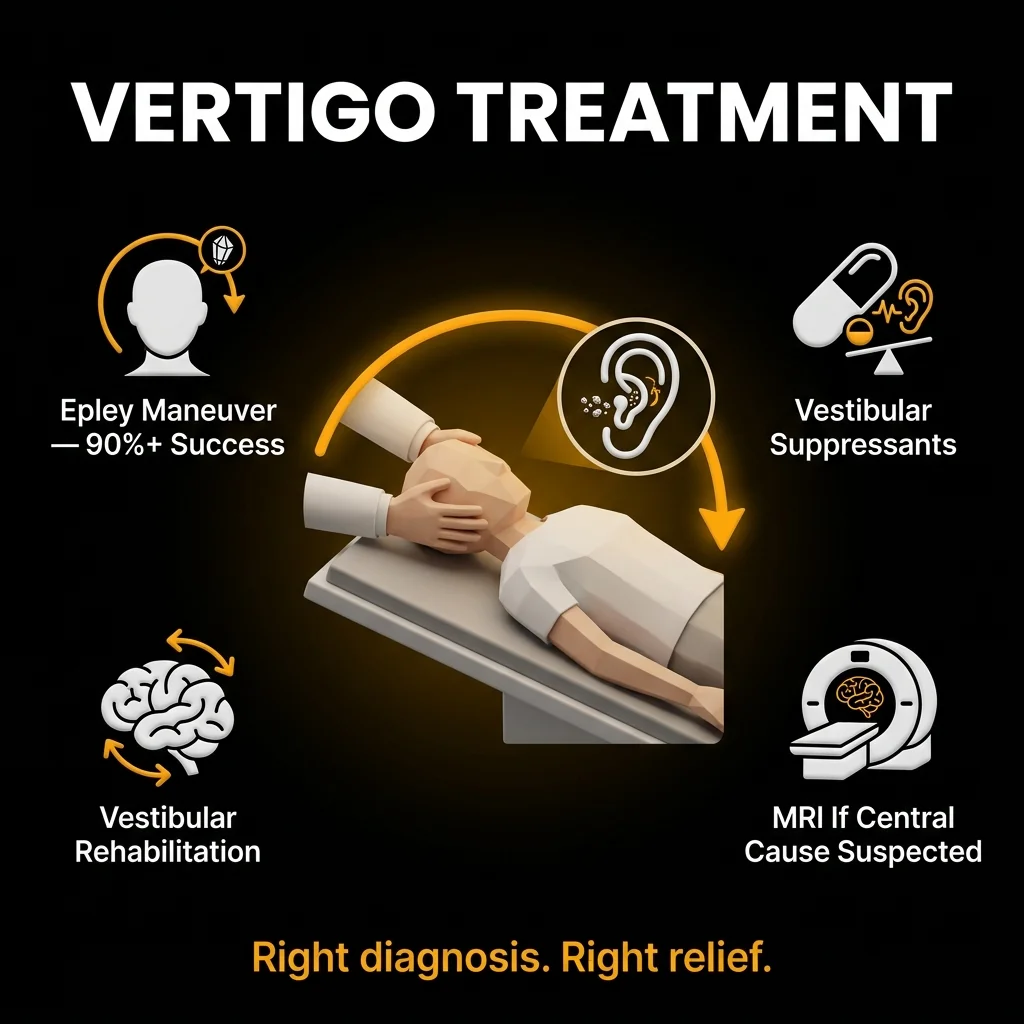
- Radiological Imaging: In cases where the physician suspects a central (brain-originated) problem, Magnetic Resonance Imaging (MRI) or Computed Tomography (CT) scans may be requested to rule out the possibility of a tumor or stroke.
How is Vertigo Treated?
Vertigo treatment is planned entirely according to the underlying cause. The most commonly applied treatment approaches are:
- Repositioning Maneuvers (Epley Maneuver, etc.): In vertigo due to crystal displacement (BPPV), the displaced crystals are repositioned through special head and neck movements performed by the physician in the clinic. Generally, a success rate of over 90% is achieved in a single session, and the patient feels immediate relief.
- Medication: Special vestibular suppressant drugs are prescribed to suppress the severe dizziness, nausea, and vomiting experienced in the acute period, and to reduce edema in the inner ear (for Meniere’s disease).
- Vestibular Rehabilitation: Special exercise programs applied in the presence of physiotherapists to enable the brain to tolerate the loss of balance in chronic balance problems.
- Surgical Intervention: In very rare and severe cases that do not respond to medication and other treatments (for example, in the presence of severe Meniere’s or a tumor), surgical intervention to the inner ear or nerve structures may be required.
Frequently Asked Questions (FAQ)
We have gathered the most frequently asked questions about the treatment and the topics our patients are most curious about for you:
What should I do during a vertigo attack?
When a vertigo attack occurs, immediately sit or lie down on a flat surface to prevent falls and injuries. Stay perfectly still and focus your eyes on a fixed point in the room. Resting in a quiet, darkened room can help your brain recalibrate and reduce sensory overload. Avoid sudden head movements, stay hydrated, and refrain from dangerous activities like driving or climbing stairs until the spinning sensation completely subsides.
Does vertigo go away on its own?
Whether vertigo goes away on its own depends entirely on the underlying cause. In cases of BPPV (the most common type), the crystals may sometimes reposition themselves naturally, or the brain may learn to adapt to the imbalance through a process called vestibular compensation. However, conditions like Meniere’s disease or inner ear infections typically require medical intervention. Even if symptoms seem to resolve, there is always a risk of recurrence, making a professional diagnosis essential for long-term relief.
Is BPPV (displaced ear crystals) dangerous?
BPPV (displaced ear crystals) is not directly life-threatening and is not a sign of a serious brain condition like a stroke or tumor. However, the severe vertigo it causes can be dangerous due to secondary risks, such as falls, injuries, or accidents while driving or operating machinery. Additionally, persistent nausea and vomiting can lead to dehydration. While the displacement itself is benign, it should be treated promptly to restore quality of life and prevent potential accidents caused by sudden loss of balance.
What foods trigger vertigo?
Diet plays a crucial role in managing vertigo, especially in maintaining the fluid balance within the inner ear. The most critical factor is limiting sodium (salt) intake, as excess salt can cause fluid retention and increase pressure in the ear (endolymphatic hydrops), triggering attacks. Additionally, patients should avoid caffeine, which can worsen symptoms by constricting blood vessels, and alcohol, which affects the composition of inner ear fluid. Excessive sugar and processed foods containing MSG should also be restricted to prevent metabolic spikes that may trigger dizziness.
Can a neck hernia (cervical herniated disc) cause vertigo?
Yes, a cervical herniated disc or other structural issues in the neck can lead to dizziness, often referred to as cervicogenic vertigo. The cervical spine contains sensory receptors that communicate with the brain regarding head position and balance. When a herniated disc compresses nerves or causes intense muscle spasms, it can disrupt these signals, leading to a sensation of imbalance. In some cases, neck issues may also interfere with blood flow through the vertebrobasilar arteries. However, since this is often a diagnosis of exclusion, it is essential to rule out inner ear or neurological conditions first.

Op. Dr. ALİ OĞUZ DEMİR
Otolaryngologist (ENT Specialist)
Following his specialization training, Dr. Ali Oğuz Demir has performed over 500 rhinoplasty surgeries. He holds a National Certificate of Professional Competence, has completed theoretical and practical training at the School of Facial Plastic Surgery, and has international clinical and observational experience from Dr. Yves Saban’s clinic in France.
Take the First Step for a New Beginning!
Clinic Address:
Contact Us
Regain Your Balance, Achieve a Healthy and Free Life
The decision for vertigo treatment is one of the most important health investments you can make in yourself to regain your quality of life. Meet our expert team to leave behind those severe dizzy spells that turn your world upside down and to step into a balanced era where you will take every step with confidence and without fear. You can contact our clinic and schedule a consultation appointment to answer all your questions and create your personalized treatment plan. We are here to help you and support you throughout this recovery process!